
Getting flagged for plagiarism or AI use can feel scary. Teachers feel pressure to protect academic integrity. Students worry that a single similarity report could hurt their grade or reputation.
Both Copyleaks and Turnitin try to solve that problem. They are plagiarism and AI content checkers used by schools, teachers, students, and content creators. They scan text, compare it against huge databases, then show how original the work is.
This guide provides a clear, quick overview of Copyleaks vs Turnitin. First comes the quick answer. After that, readers who want more detail get a deeper comparison of accuracy, AI detection, databases, pricing, and real user feedback.
Quick Answer: Copyleaks vs Turnitin in One Minute
In simple terms: Copyleaks is usually better for flexible use, multilingual work, AI detection, and people who are not tied to a big institution. Turnitin is usually better for large schools and universities that want a standard system across many classes and rely on a huge academic database.
Here is a quick summary table.
| Feature | Copyleaks | Turnitin |
|---|---|---|
| Plagiarism detection accuracy | Very strong, great for web, code, and many formats | Very strong, especially for classic academic papers |
| AI detection | Leads recent tests, strong in many languages | Solid, focused on academic-style AI writing |
| Databases and coverage | Web, open academic content, code, 100+ languages | Massive academic database, student papers, journals |
| Ease of use | Modern, cleaner user interface | Rich but can feel crowded at first |
| Integrations | APIs, LMS links, good for flexible workflows | Deep LMS ties in many institutions |
| Reporting features | Visual heatmaps, clear side-by-side matches | Detailed academic-style similarity reports |
| Pricing style | Subscriptions and usage-based plans | Institutional licenses for schools and universities |
| Best for | Mixed users, smaller schools, creators, businesses | Large academic institutions and strict workflows |
Readers who want details on accuracy, AI detection, or pricing can find them in the comparison and pricing sections below.
What Are Copyleaks and Turnitin? Basics for Students and Teachers
Plagiarism detection is simple in idea. A tool checks a document against other texts and finds overlap. It helps protect academic integrity and content originality by showing where words or ideas match existing sources.
A similarity checker powers this. It runs assignment scanning in the background, compares text against many databases, and then generates a report with a percentage score and links to possible sources. Both Copyleaks and Turnitin work this way.
Today, these tools do more than catch copy-paste. They also try to spot AI-generated content. That means they look for patterns that match writing from large language models, not just direct text matches from the web.
Plain-language overview of Turnitin
Turnitin is one of the oldest and best-known plagiarism tools in education. Many students first meet it through their learning management system, such as Canvas, Moodle, or Blackboard.
Turnitin checks student papers against:
-
\t
- A massive database of past student submissions
- Many scholarly journals and books
- Parts of the public internet
\t
\t
It is mostly sold to schools and universities, not to single users. For many teachers, Turnitin is the standard tool for academic integrity and traditional plagiarism detection.
Plain-language overview of Copyleaks
Copyleaks is a newer but fast-growing plagiarism and AI content checker. It is used by schools, companies, publishers, and individual writers.
Copyleaks can:
-
\t
- Scan many file types, including Office files, PDFs, and code
- Work in more than 100 languages
- Check web content, business documents, and academic work
\t
\t
Individual teachers, tutors, students, and bloggers can sign up directly. That makes it easier to use Copyleaks outside large institutions.
Why academic integrity and originality matter more in 2025
AI writing tools and easy copy-paste from the internet create new risks. A student can generate a full essay in seconds. A blog writer can pull whole sections from another site without noticing.
Schools and writers now depend on tools to maintain academic integrity and protect the originality of their content. Good detection tools help:
-
\t
- Catch serious plagiarism
- Teach better citation habits
- Support honest work instead of shortcuts
\t
\t
They are not perfect, but they are part of basic educational software in many classrooms.
Copyleaks vs Turnitin: Feature-by-Feature Comparison
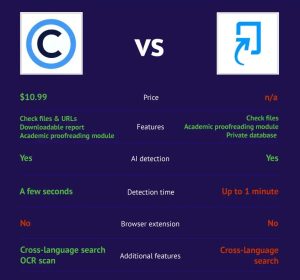
This section compares Copyleaks and Turnitin on the points that matter most: detection accuracy, AI detection, databases, user interface, integration options, reporting features, and privacy.
Independent tests in 2025, such as the comparison at AcademicHelp’s Copyleaks vs Turnitin review, show clear differences between the two tools.
Detection accuracy and how each tool finds plagiarism
Detection accuracy is about how well a tool finds real matches without missing too much or over-flagging harmless text.
Both tools use comparison algorithms that:
-
\t
- Break text into smaller pieces
- Compare those pieces with large databases
- Look for identical or very similar strings and structures
\t
\t
Turnitin shines for traditional academic plagiarism. Its strength comes from decades of student submissions and publisher deals. If a student reuses an old paper from the same university, Turnitin is very likely to catch it.
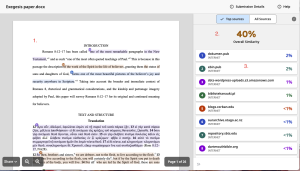
Copyleaks is strong across content types. It checks:
-
\t
- Public web pages
- Open academic sources
- Code repositories
- Documents in many languages
\t
\t
\t
Copyleaks is also known for strong paraphrase detection in several languages. It looks at sentence structure and meaning, not only word-for-word copying.
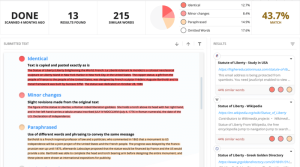
AI content detection: which one is better for AI-generated text?
AI content is now a core concern. Teachers worry about full AI-written essays. Students worry that AI-assisted edits will get flagged.
Recent testing in 2025, including reports from Skyline Academic’s AI plagiarism checker review, often ranks Copyleaks at or near the top for AI detection accuracy. It can detect AI-generated text in many languages and formats.
Turnitin also offers AI detection, mainly tuned for academic-style English writing. Reviews from universities show that it works, but its accuracy is usually rated as moderate compared with Copyleaks and some newer tools.
For many users, the real concern is simple: will AI-assisted writing get flagged?
Key points:
-
\t
- Both tools can mark text as likely AI-written
- Short grammar fixes or light rephrasing are less risky than full AI-generated essays
- Human review by teachers remains essential before any claim of cheating
\t
\t
Readers who want a broader view of AI content detection tools can compare how Copyleaks and Turnitin appear in wider AI detector roundups at sources like ZDNET’s AI detector overview.
Databases and content coverage: what each tool actually checks
Turnitin and Copyleaks check different types of content, even if they overlap in some areas.
Turnitin database focus:
-
\t
- Massive archive of student papers from thousands of institutions
- Many academic journals and books
- Selected web content
\t
\t
Copyleaks coverage:
-
\t
- Billions of public web pages
- Open academic content and some institutional agreements
- Code bases and technical documents
- Strong multilingual content with cross-language checks
\t
\t
\t
For a school that cares mainly about matches with past student work and closed academic content, Turnitin often has the edge. For web-heavy content, blogs, business documents, or multi-language work, Copyleaks is usually stronger.
User interface, reports, and ease of use
The user interface shapes how easy it is to use a tool for daily assignment scanning.
Turnitin offers a classic academic interface. It plugs into many LMS platforms, so students submit work as usual and see a similarity score. Reports can feel dense at first, with layers of options and filters, but they offer detailed views for experienced teachers.
Copyleaks focuses on a cleaner, more modern layout. Many users describe:
-
\t
- Simple upload flows
- Visual heatmaps of matching passages
- Side-by-side view of the student text and the source
\t
\t
For someone new to plagiarism detection, Copyleaks reports are often easier to read. Both tools highlight matching text and show its source, but Copyleaks leans more toward visual design.
Comparisons of the best plagiarism checkers for students often note this difference in how quickly a first-time user can read and understand a report.
Integrations, workflows, and privacy of student work
Integration and privacy are major concerns for schools.
Integration options and workflows
-
\t
- Turnitin ties deeply into many learning management systems. In many colleges, it is already built into Canvas, Moodle, or Blackboard. Teachers can enable plagiarism checks during the normal assignment setup.
- Copyleaks offers LMS integrations, including Canvas, and also provides APIs that let schools, companies, or platforms plug plagiarism detection into their own systems or websites.
\t
Turnitin is often the smoother fit for large, existing academic workflows. Copyleaks can feel more flexible for mixed use, such as schools plus business units or content teams.
Privacy and data handling
Both tools store uploaded documents on secure servers. Institutions can often choose:
-
\t
- Whether student papers are stored long term
- Whether papers are added to a private database for future checks
- How long are reports kept
\t
\t
Some students worry about their work being kept forever. Schools usually address this through policies and settings. Copyleaks promotes strong encryption and privacy controls, while Turnitin relies on long-standing institutional agreements.
A recent update from Southern Methodist University, for example, explained its move toward Copyleaks for plagiarism detection and academic integrity needs in a campus blog post at SMU IT Connect.
Pricing and Value: Who Gets the Better Deal?
Exact prices change often, so the focus here is on how each tool sells access and where users get the best value.
Turnitin is usually sold through institutional licenses. A university or school district signs a contract, and students use it through the LMS or a portal. Individual students rarely pay Turnitin directly.
Copyleaks offers more flexible plans:
-
\t
- Subscriptions or credit-based models
- Options for solo users, small teams, and larger organizations
- Different bundles for education, business, or publishing
\t
\t
For many individual users, Copyleaks is the more realistic choice.
How Turnitin licensing usually works for schools
The institution buys Turnitin. Costs are often bundled with other educational software. Some packages include tools like Feedback Studio.
This setup gives strong value if a school runs thousands of assignment scans across many courses. It is less useful for a single teacher or tutor who is not part of a large contract.
Turnitin is not a pay-per-use tool in the usual sense. Access depends on whether a school has signed up.
How Copyleaks prices plans for individuals and organizations
Copyleaks offers tiered pricing. Common patterns include:
-
\t
- Low-volume plans for individual teachers or students
- Larger plans for schools, colleges, or companies
- Volume-based pricing that scales as usage grows
\t
\t
Heavy users may hit overage costs if they scan many long documents, but starting small is easy. For solo educators, content agencies, or marketing teams, Copyleaks is often easier to buy and test than Turnitin.
Writers and editors looking for a plagiarism checker for bloggers and content creators often pick Copyleaks or similar tools because they can sign up without going through an institution.
Real-world Feedback: What Users Like and Dislike
Reviews and user tests in 2025, including comparisons like TechDictionary’s Copyleaks vs Turnitin article, show clear patterns in pros and cons.
Copyleaks: common pros and cons from real users
Common positives:
-
\t
- Strong AI and paraphrase detection in many languages
- User-friendly reports with visual highlights
- Support for code and multiple file formats
- Flexible pricing for individuals and small teams
\t
\t
\t
Common negatives:
-
\t
- AI detection can feel strict for very polished writing
- Overage fees or higher tiers for heavy scanning
- Less famous name in traditional academia, so some admins move slowly
\t
\t
Turnitin: common pros and cons from real users
Common positives:
-
\t
- Trusted brand in education
- Very strong at classic academic plagiarism detection
- Deep LMS integration and large institutional presence
- Detailed reports suited to formal academic policy
\t
\t
\t
Common negatives:
-
\t
- Interface can feel complex or dated for new users
- Higher overall cost tied to institutional contracts
- Less flexible for non-academic or mixed content workflows
- Ongoing questions from some students about the long-term storage of papers
\t
\t
\t
In practice, many large schools still select Turnitin for its academic depth. Tutors, freelancers, and content teams often find it too heavy and choose Copyleaks or other tools instead.
People Also Ask About Copyleaks vs Turnitin
Is Turnitin more accurate than Copyleaks?
For traditional academic plagiarism, Turnitin is often seen as slightly stronger because of its massive academic database and long history in universities. It is very good at catching reuse of past student papers and formal journal content.
For AI detection and multilingual work, recent tests in 2025 tend to place Copyleaks ahead. Copyleaks often spots more AI-written content in different languages and formats. In short, for classic academic overlap, Turnitin may lead, while for AI detection and mixed content, Copyleaks is at least as useful.
Which AI detector is as good as Turnitin?
Copyleaks is one of the closest options, and in many tests, it now outperforms Turnitin on AI content. It supports multiple languages, code, and web content, making it useful for schools and businesses.
Other tools sometimes appear in AI detector lists, such as those reviewed in AI detector roundups, but the main Copyleaks vs Turnitin comparison still matters most for academic settings. The best AI detector depends on content type, language, and how strictly a school or writer wants to treat AI help.
Is 25% on Turnitin too high?
A similarity score is the percentage of text that matches other sources in the database. A 25 percent score does not automatically mean plagiarism.
Quotations, references, and common phrases all add to the score. For some essay types, such as literature reviews with many cited quotes, 25 percent can be normal. For papers with many complete sentences copied from sources, 25 percent might be a warning sign. Teachers usually care more about what is matched and how it is cited than the number alone.
Is Copyleaks free or paid?
Copyleaks offers limited, unrestricted-use or trial options from time to time, but serious or regular use requires a paid plan. Plans differ for individual users, educators, and organizations.
Because people can start with smaller plans, Copyleaks feels more flexible than Turnitin for solo users. Many students or teachers test it on a few documents before deciding on a larger subscription.
Can Copyleaks or Turnitin detect paraphrased content?
Yes. Both tools go beyond pure copy-paste checks. Their comparison algorithms consider sentence structure and similar wording, not just exact matches.
Copyleaks is often praised for catching paraphrased content in multiple languages. Turnitin is strong at identifying paraphrases from academic sources or past student work. Even with good paraphrasing, proper citation is still required.
Will Copyleaks or Turnitin say that cheating is happening if AI is used as a helper?
Both tools can flag text that appears entirely written by AI. If AI is used only for ideas, basic outlines, or light editing, and the writer rewrites in their own words and cites where needed, the risk of being flagged drops, but does not disappear.
Most experts agree that humans should always review AI reports. Schools are also writing more explicit rules so students know what counts as acceptable AI help in assignments.
Who Should Choose Copyleaks vs Who Should Choose Turnitin?
The key question is which is better, Copyleaks or Turnitin, for a specific role, budget, and kind of writing.
Copyleaks is usually better if you are…
-
\t
- An individual student who wants private checks before submitting work
- A tutor or teacher working outside a big institution
- An international school with many languages in daily use
- A blogger or content creator checking web articles
- An agency that handles website copy or marketing content
- A business protecting the originality of reports or documentation
\t
\t
\t
\t
\t
Guides on avoiding plagiarism in academic writing often recommend using a flexible tool like Copyleaks during drafting and revision.
Turnitin is usually better if you are…
-
\t
- A large high school, college, or university that needs a standard system
- An academic department that relies on LMS integration and strict workflows
- An institution that values Turnitin’s long record and brand recognition
- A school that runs thousands of assignment scans across many courses
\t
\t
\t
Turnitin is best suited when an institution can fund an enterprise license and wants a single, central solution across the campus.
Side-by-Side Comparison Table: Copyleaks vs Turnitin
| Aspect | Copyleaks | Turnitin |
|---|---|---|
| Plagiarism detection accuracy | High, across web, code, and multi-format content | High, especially for academic essays and journals |
| AI detection strength | Very strong, top results in many 2025 tests | Solid, more focused on academic English |
| Database focus | Web, open academic, code, 100+ languages | Closed academic database, student papers, journals |
| Ease of use | Clean, modern, quick to learn | Powerful but can feel complex |
| Integration options | APIs, LMS connectors, good for mixed workflows | Deep LMS integration in many institutions |
| Reporting clarity | Visual heatmaps, side-by-side views | Detailed academic-style similarity reports |
| Privacy and control | Strong privacy settings, flexible storage choices | Institution-level policies and settings |
| Pricing style | Subscription or usage-based, works for individuals | Institutional licenses, campus-wide |
| Best for | Mixed users, smaller schools, creators, businesses | Large schools and universities focused on scale |
For design, a simple side-by-side graphic can help: icons for accuracy, ease of use, and value, plus small badges such as “Best for institutions” and “Best for mixed users”. Readers who also write online often look for the best plagiarism checkers for students as part of this wider choice.
Extra FAQs About Plagiarism Checkers and Academic Integrity
Do I need a plagiarism checker if I always write in my own words?
Even honest students can repeat notes verbatim or forget a citation. A checker can catch these small issues before a teacher reads the work.
Think of the tool as a final safety step, not a replacement for learning citations.
What is a “good” similarity score on Copyleaks or Turnitin?
There is no single number that fits every assignment. Short essays with few quotes may be under 10 percent. Research papers with many citations may be higher.
Teachers usually set expectations. They care more about whether matched text is cited correctly than the raw score.
Can I use both Copyleaks and Turnitin on the same paper?
In many cases, yes. A student might run a draft through Copyleaks, then submit to a course that uses Turnitin.
The two tools use different databases and algorithms, so scores may not match exactly. Using both can offer more peace of mind, as long as each system’s rules are respected.
Will using a plagiarism checker hurt grades?
Running a personal check before submission will not hurt grades. If anything, it can help by showing problems early.
Grades depend on the version the teacher receives. Fixing issues that the checker finds is the key step.
How can I avoid plagiarism in academic writing in the first place?
Helpful habits include:
-
\t
- Taking clear notes and marking direct quotes
- Using quotation marks when copying exact words
- Paraphrasing in a personal voice, then citing the source
- Keeping a list of all sources from the start
- Running a final scan with a trusted tool
\t
\t
\t
\t
Many study skills guides on avoiding plagiarism in academic writing stress the same steps.
Are plagiarism checkers 100% accurate?
No plagiarism checker is perfect. Some copied text might slip through, and some honest writing might be flagged.
Because of this, final decisions should always be made by a human teacher or editor, not solely by software.
Conclusion
The Copyleaks vs Turnitin choice is not about a single winner for everyone. Copyleaks is usually the better fit for flexible users, multi-language work, individuals, content creators, and mixed academic plus business use. Turnitin is generally a better fit for large schools and universities that prioritize academic integrity at scale and rely on deep LMS integration.
The best approach is simple: pick the tool that matches your role, budget, and writing style, then test it on a sample assignment. Combine that tool with good writing habits, honest citation, and clear classroom rules about AI.
Readers who want to go further can explore guides on AI content-detection tools, tools to maintain academic integrity, and practical advice on avoiding plagiarism.
SEE ALSO: AI Lyrics Generator Guide: Turn Simple Ideas Into Full Songs In 2025
2 thoughts on “Copyleaks vs Turnitin: Which Plagiarism Checker & AI Detector Is Best for Students and Teachers?”